
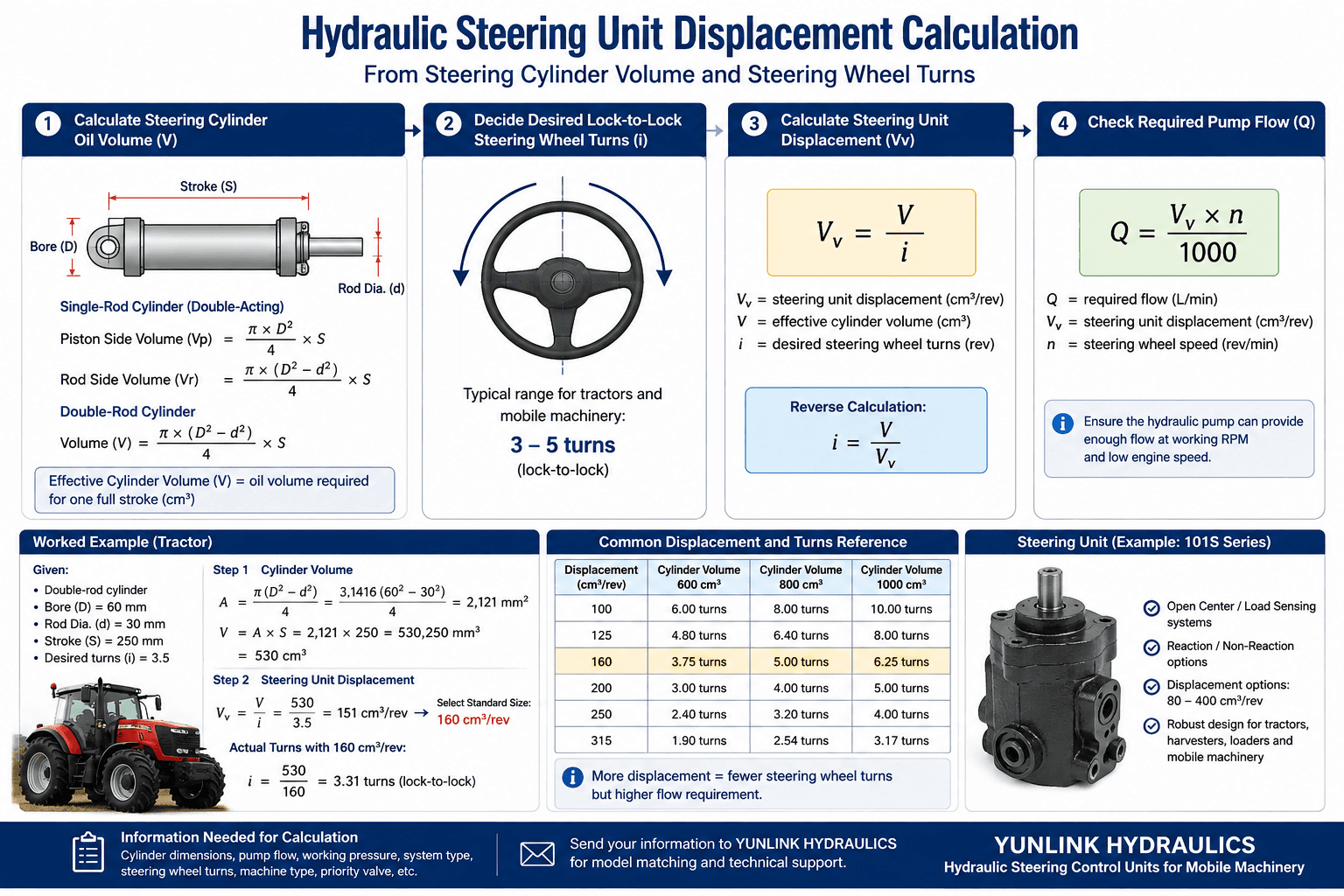
Hydraulic steering unit displacement calculation starts with the effective steering cylinder volume and the desired number of lock-to-lock steering wheel turns.
Selecting a hydraulic steering unit is not only about matching the port threads, mounting flange or outside dimensions.
For a new steering system or an OEM application, one of the most important questions is:
What steering unit displacement should be used?
The answer depends mainly on the effective oil volume of the steering cylinder and the desired number of steering wheel revolutions from full left lock to full right lock.
This guide explains how to calculate hydraulic steering unit displacement, estimate steering wheel turns and check whether the hydraulic pump can provide sufficient steering flow.
For broader selection guidance, see our Hydraulic Steering Unit Selection Guide.
The Basic Relationship Between Cylinder Volume and Steering Unit Displacement
Hydraulic steering unit displacement is normally expressed in:
cm³/rev or cc/rev
This represents the theoretical volume of oil delivered by the steering unit for each revolution of the steering wheel.
The basic relationship is:
Steering Unit Displacement = Effective Cylinder Stroke Volume ÷ Desired Steering Wheel Turns
Or:
Vv = V ÷ i
Where:
- Vv = steering unit displacement, cm³/rev
- V = effective steering cylinder oil volume, cm³
- i = desired steering wheel revolutions from lock to lock
The reverse calculation can also be used:
Steering Wheel Turns = Cylinder Stroke Volume ÷ Steering Unit Displacement
This relationship provides the starting point for steering unit sizing.
However, the correct cylinder volume must be determined first.
Step 1: Identify the Steering Cylinder Configuration
Before calculating displacement, determine what type of steering cylinder is used.
The most common configurations include:
- Single-rod double-acting cylinder
- Double-rod cylinder
- Two-cylinder steering arrangement
- Specialized axle-integrated steering cylinders
The calculation is not identical for every configuration.
Single-Rod Double-Acting Cylinder
A conventional single-rod cylinder has different effective areas on its two sides.
The piston side volume is calculated using:
Vp = π × D² ÷ 4 × S
Where:
- Vp = piston-side volume
- D = cylinder bore diameter
- S = cylinder stroke
The rod-side effective volume is:
Vr = π × (D² − d²) ÷ 4 × S
Where:
- d = piston rod diameter
Because the piston side and rod side have different effective areas, the oil volume required for left and right steering may not be identical.
As a result, a steering system using a single-rod cylinder can require slightly different numbers of steering wheel turns in the two directions.
This is normal and should be considered during system design.
Double-Rod Cylinder
A double-rod cylinder generally has the same effective piston area on both sides when both rods have the same diameter.
The effective volume for one complete cylinder stroke is:
V = π × (D² − d²) ÷ 4 × S
Because the effective areas are equal, left and right steering volumes are normally symmetrical.
This makes steering wheel turns more consistent in both directions.
Step 2: Calculate the Effective Cylinder Oil Volume
Consider an example using a double-rod steering cylinder.
Assume:
- Cylinder bore: 60 mm
- Rod diameter: 30 mm
- Stroke: 250 mm
First calculate the effective annular area:
A = π × (60² − 30²) ÷ 4
A ≈ 2,121 mm²
Then multiply by the stroke:
V = 2,121 × 250
V ≈ 530,250 mm³
Because:
1 cm³ = 1,000 mm³
The cylinder stroke volume is approximately:
530 cm³
This means approximately 530 cm³ of oil is required to move the cylinder through its full effective stroke.
Step 3: Decide the Desired Lock-to-Lock Steering Wheel Turns
The next step is deciding how many steering wheel revolutions are desired from full left steering lock to full right steering lock.
For many mobile hydraulic steering systems, approximately:
3 to 5 steering wheel revolutions lock-to-lock
is a practical starting range.
The correct value depends on:
- Machine type
- Vehicle speed
- Front axle load
- Steering geometry
- Operator response requirements
- Tire size
- Steering cylinder dimensions
- Hydraulic system characteristics
A smaller number of steering wheel turns normally creates faster steering response.
A larger number of turns generally creates slower and more gradual steering response.
For tractors and other mobile equipment, very fast steering is not automatically better.
The steering response must remain controllable during normal operation.
Step 4: Calculate the Required Steering Unit Displacement
Using the previous cylinder example:
Cylinder volume = 530 cm³
Assume the target is:
3.5 steering wheel turns lock-to-lock
Then:
Steering unit displacement = 530 ÷ 3.5
≈ 151 cm³/rev
A standard steering unit near:
160 cm³/rev
may therefore be a reasonable initial candidate.
For available product series, see our Hydraulic Steering Units.
After selecting the nearest available standard displacement, recalculate the actual steering wheel turns.
Using 160 cm³/rev:
530 ÷ 160 = 3.31 turns
The estimated steering wheel travel would therefore be approximately:
3.3 turns lock-to-lock
This is the value that should be evaluated against the actual machine requirements.
Hydraulic Steering Unit Displacement Calculation Example
Consider a tractor steering system with an effective full-stroke cylinder volume of:
680 cm³
The design target is approximately:
3.5 steering wheel turns lock-to-lock
Calculate the required displacement:
680 ÷ 3.5 = 194 cm³/rev
The nearest common steering unit displacement might be:
200 cm³/rev
Recalculate the number of steering wheel turns:
680 ÷ 200 = 3.4 turns
So a 200 cm³/rev steering unit would theoretically provide approximately:
3.4 steering wheel turns lock-to-lock
This is very close to the original design target.
However, this calculation is only one part of the complete steering system design.
Pressure, pump flow, steering cylinder force, system type and priority valve configuration must still be checked.
Why 100 cc/rev and 200 cc/rev Do Not Feel the Same
Assume the same steering cylinder requires:
600 cm³ of oil for full movement.
With a 100 cc/rev steering unit:
600 ÷ 100 = 6 turns
With a 160 cc/rev steering unit:
600 ÷ 160 = 3.75 turns
With a 200 cc/rev steering unit:
600 ÷ 200 = 3 turns
With a 250 cc/rev steering unit:
600 ÷ 250 = 2.4 turns
This demonstrates why displacement has a major influence on steering response.
Increasing displacement reduces the number of steering wheel turns required to move the cylinder.
However, increasing steering unit displacement also increases the oil flow required when the operator turns the steering wheel at the same speed.
Therefore, steering unit displacement and pump flow should always be evaluated together.
Step 5: Calculate Required Steering Pump Flow
After determining steering unit displacement, check whether the hydraulic system can supply sufficient oil flow.
The theoretical relationship is:
Q = Vv × n ÷ 1,000
Where:
- Q = required flow in L/min
- Vv = steering unit displacement in cm³/rev
- n = steering wheel rotational speed in rev/min
For example, using:
- Steering unit displacement: 200 cm³/rev
- Steering wheel speed: 100 rev/min
The required flow is:
Q = 200 × 100 ÷ 1,000
Q = 20 L/min
If the steering wheel is turned at 120 rev/min:
Q = 200 × 120 ÷ 1,000
Q = 24 L/min
This shows why installing a larger-displacement steering unit without checking available pump flow may create poor steering performance.
If the pump cannot provide enough oil, the steering wheel cannot maintain the desired steering speed.
What Happens at Low Engine Speed?
This point is particularly important on tractors.
A tractor hydraulic pump is often mechanically driven by the engine.
At low engine rpm, the available pump flow may be substantially lower than at rated engine speed.
Therefore, a steering system that works well at high engine speed may feel slow when the engine is idling if the available steering flow is insufficient.
When evaluating an OEM steering system, check pump flow under several conditions:
- Engine idle
- Normal operating rpm
- Maximum expected steering demand
- Simultaneous use of working hydraulics
Steering performance should not be evaluated only using the pump’s maximum rated flow.
Why a Priority Valve Matters
Many tractors use one hydraulic pump for both steering and working hydraulic functions.
Examples of other hydraulic consumers include:
- Three-point hitch
- Front loader
- Hydraulic cylinders
- Auxiliary hydraulic outlets
- Implement control systems
In this type of system, steering must normally receive priority over secondary hydraulic functions.
A priority valve can reserve sufficient flow for steering before excess flow is supplied to the working hydraulic circuit.
This is especially important during conditions such as:
- Low engine speed
- Loader operation
- Simultaneous implement movement
- Rapid steering input
Without appropriate flow priority, steering performance may change when other hydraulic functions are operated.
For load-sensing steering systems, the steering unit, priority valve and pump circuit must be designed as a complete system.
Single-Rod Cylinders Can Produce Different Left and Right Steering Turns
This is an important detail that is often missed during steering unit selection.
With a single-rod cylinder:
Piston-side area > Rod-side area
Therefore:
Piston-side oil volume > Rod-side oil volume
If the same steering unit displacement is used in both directions, the steering wheel may require more revolutions in one direction than the other.
For example:
- Piston-side volume: 620 cm³
- Rod-side volume: 500 cm³
- Steering unit displacement: 160 cm³/rev
Estimated turns:
620 ÷ 160 = 3.88 turns
and:
500 ÷ 160 = 3.13 turns
The steering wheel travel would therefore not be symmetrical.
Whether this is acceptable depends on the machine design.
Do not assume that every hydraulic steering system should automatically have identical left and right steering wheel turns.
Two-Cylinder Steering Systems Need a System-Level Calculation
Some tractors, loaders and heavy mobile machines use two steering cylinders.
In these systems, do not simply calculate one cylinder and multiply by two without first identifying the hydraulic connection and steering geometry.
Depending on the circuit:
- One cylinder may extend while the other retracts
- Oil volumes may combine differently
- Rod dimensions may affect the total effective volume
- Steering linkage geometry may affect required stroke
For a two-cylinder system, calculate the actual volume transferred through the complete steering circuit for a full lock-to-lock movement.
The hydraulic schematic should be reviewed before selecting steering unit displacement.
Choosing Between Common Steering Unit Displacements
Typical displacement options may include values such as:
- 80 cc/rev
- 100 cc/rev
- 125 cc/rev
- 160 cc/rev
- 200 cc/rev
- 250 cc/rev
- 315 cc/rev
- 400 cc/rev
The correct size should not be chosen simply according to tractor horsepower or machine weight.
Instead, start with:
Cylinder volume → Target turns → Required displacement
Then verify:
- Available pump flow
- Working pressure
- Steering cylinder force
- Hydraulic system type
- Mechanical steering geometry
- Priority valve requirements
Machine size can provide an initial reference, but the hydraulic calculations should determine the final choice.
Common Steering Calculation Mistakes
Choosing displacement by machine size only
Two tractors of similar horsepower may use different steering cylinders and steering geometries.
The same steering unit displacement may therefore not be suitable for both.
Ignoring the piston rod
For a single-rod cylinder, calculating both sides using the full piston area gives incorrect results.
The rod-side effective area must subtract the piston rod area.
Assuming left and right turns must be identical
Single-rod steering cylinders can naturally produce different oil volumes in each direction.
Selecting a larger displacement to make steering faster
A larger steering unit reduces steering wheel turns, but it also requires more hydraulic flow at a given steering wheel speed.
Ignoring low-rpm pump flow
A steering system should remain usable when the engine is operating at low speed.
Ignoring the priority circuit
When steering and working hydraulics share a pump, available steering flow can change unless the hydraulic circuit manages flow priority correctly.
Calculating displacement but ignoring pressure
Displacement determines oil volume per steering wheel revolution.
It does not determine whether the cylinder produces enough steering force.
Steering pressure and cylinder effective area must also be sufficient to overcome the axle and tire steering loads.
Replacement Applications Are Different from New System Design
For an existing tractor or machine, calculating displacement from scratch is not always the best first step.
For OEM projects, hydraulic steering unit displacement calculation should always be checked together with pump flow, steering pressure and cylinder configuration.
If the original steering system worked correctly, the safest approach is usually to identify and match:
- Original steering unit model
- Displacement
- Open-center or load-sensing configuration
- Reaction or non-reaction function
- Pressure rating
- Port thread
- Mounting flange
- Input shaft
Engineering calculations become particularly useful when:
- The original model cannot be identified
- The steering cylinder has been replaced
- The steering geometry has changed
- A machine is being converted to full hydraulic steering
- An OEM is developing a new machine
- Steering response needs to be redesigned
Information Needed for Steering System Calculation
For a preliminary steering unit calculation, provide:
Steering cylinder information
- Cylinder bore diameter
- Piston rod diameter
- Cylinder stroke
- Single-rod or double-rod design
- Number of steering cylinders
Hydraulic system information
- Pump flow at operating rpm
- Pump flow at engine idle
- Maximum system pressure
- Steering relief pressure
- Open-center or load-sensing circuit
- Priority valve information
Machine information
- Machine type
- Tractor or vehicle model
- Front axle configuration
- Tire size
- Approximate axle load
- Required steering angle
- Desired lock-to-lock steering wheel turns
Existing steering unit information
If replacing an existing unit, also provide:
- Manufacturer
- Model number
- Displacement
- Nameplate photo
- Port photos
- Mounting dimensions
- Shaft dimensions
The more complete the information, the more accurately the steering unit can be matched.
Steering Unit Calculation Checklist
Before confirming a steering unit, verify:
- Cylinder configuration identified correctly
- Effective cylinder volume calculated correctly
- Target lock-to-lock turns established
- Steering unit displacement calculated
- Actual turns recalculated using the selected standard displacement
- Pump flow checked
- Low-engine-speed flow checked
- Steering pressure checked
- Priority valve requirement checked
- Open-center or load-sensing system confirmed
- Reaction or non-reaction function confirmed
- Ports and threads confirmed
- Mounting and shaft dimensions confirmed
Final Selection Guidance
The basic relationship for steering unit sizing is straightforward:
Cylinder Volume ÷ Steering Wheel Turns = Steering Unit Displacement
But a reliable hydraulic steering system requires more than one calculation.
Cylinder configuration, pump flow, operating pressure, steering geometry and hydraulic circuit design all affect the final result.
For replacement applications, matching the original steering unit specification is normally the safest starting point.
For new tractor and mobile machinery projects, calculate the steering cylinder volume first, determine the desired steering wheel turns, select the nearest suitable steering unit displacement, and then verify pump flow and steering pressure.
YUNLINK HYDRAULICS supplies 101S series hydraulic steering control units for tractors, harvesters, loaders, forklifts and other mobile machinery.
For open-center product options, see our 101S-1 & 101S-2 Series Hydraulic Steering Control Units. For load-sensing product options, see our 101(S)-5T & 101(S)-7T Series Hydraulic Steering Control Units.
For model matching or new steering system projects, send the steering cylinder dimensions, pump flow, working pressure, hydraulic circuit information and required steering wheel turns for technical review.